



Europas-Werte-Wanderweg

Schild16-9-Wegweiser-Europaunion-Wertewanderweg
🠶 Station 2 -Legal Basis
The values of the European Union have various sources, but are all enshrined in Article 2 of the Treaty on European Union.

Current relevance

Where are the shared European values found?
Bible
International Law
Magna
Charta
Philosophy
Déclaration
des Droits de
l’Homme et du
Citoyen
Thora

Background information

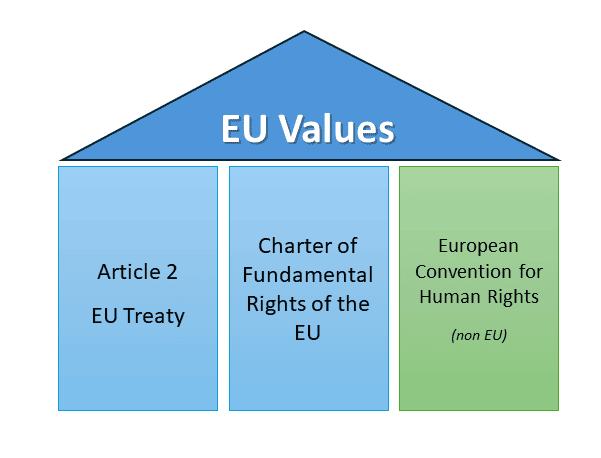
The common values of the EU are based on three legal pillars:

The Member States have set out the tasks, functioning and objectives of the European Union in the Treaty on European Union (TEU) and had these confirmed by their parliaments. The EU’s common values are listed in Article 2 of the Treaty.

In addition, there is the Charter of Fundamental Rights of the EU, which was drawn up as early as 2000 but only became binding on the EU and its Member States with the Treaty of Lisbon. It contains more rights than Article 2 of the TEU.

The European Convention on Human Rights, adopted by the Council of Europe as early as 1950 (which is not an EU body but predates the EU institutions), should be regarded as the third pillar of the protection of fundamental and human rights. All EU Member States must have signed this Convention.

Article 2 Treaty on the European Union

These values are binding for EU institutions and bodies in all their activities. Member States, national courts and the European Court of Justice must also comply with them when implementing, applying and interpreting EU law.  

These values are enshrined in the constitutions of most European countries, where they can be legally enforced by individual citizens. Their inclusion in the EU Treaty emphasises their importance and obliges Member States to apply them also when dealing with each other: the principles of tolerance, justice, solidarity and non-discrimination also apply between the countries of Europe.  

Article 2 Treaty on the European Union

The Union is founded on the values of respect for human dignity, freedom, democracy, equality, the
rule of law and respect for human rights, including the rights of persons belonging to minorities
.
These values are common to the Member States in a society in which pluralism, non-discrimination,
tolerance, justice, solidarity and equality between women and men prevail.

The Union is founded on the values of respect for human dignity, freedom, democracy, equality, the
rule of law and respect for human rights, including the rights of persons belonging to minorities
.
These values are common to the Member States in a society in which pluralism, non-discrimination,
tolerance, justice, solidarity and equality between women and men prevail.

Politics and values – a pair that can’t be taken for granted

The idea, so familiar to us Europeans today, that decisions in states are made collectively based on democratic principles, or that there are fundamental human and civil rights that the state must actively protect, must not be taken for granted. As dictatorships of all kinds show, political power can certainly be exercised without democracy and the rule of law. Our modern understanding is the result of centuries of often painful lessons and (civil) wars, in which we have learned, among other things, that

  • dictatorships do not care about citizen participation and fundamental rights
  • even elected parliamentary majorities can pave the way for totalitarian rule
  • democratic movements are often brutally oppressed by those in power
  • tolerance towards others and people who think differently can very quickly turn into hatred and exclusion
  • talking to each other, negotiating and seeking compromise is time-consuming and often annoying, but certainly leads to fewer wars than the unilateral ruling of a supposedly benevolent leader would, which is what some people long for.

A shared heritage of great ideas

“Drawing inspiration from the cultural, religious and humanist inheritance of Europe […]” This is how the EU Treaty begins. This heritage also includes ideas about important values that characterise us Europeans and our way of thinking and acting. These are, for example, fundamental ideas of Greco-Roman philosophy, such as critical thinking, the rule of reason, the value of virtues, and the distinction between monarchy, aristocracy and democracy. The humanist educational movement revived these ideas and values during the Renaissance period, but placed the individual at the centre: every person should be able to develop their personality and dignity to the fullest extent possible.

Throughout Europe, Reformation paved the way for a greater separation of church and state (known as secularisation), although this did not take hold to the same extent in all countries. The Age of Enlightenment continues to shape our society today with its belief in scientific knowledge, the necessity for separation of powers and the idea of popular sovereignty, as well as the right to individual self-determination and independence.


A long road to Article 2 TEU

Including universally applicable values and fundamental rights in the Community treaties is neither self-evident nor was it intended from the outset: the only value already mentioned in Article 7 of the 1957 Treaty establishing the European Economic Community (EEC) is the prohibition of discrimination on grounds of nationality.

This international treaty concluded between sovereign states did not contain or require any provisions regarding solidarity or democracy. Cooperation was primarily intended to reduce trade barriers – and not to establish a political community that would have implications on the rights and obligations of citizens in the contracting states

It was not until 45 years later, when the Maastricht Treaty on European Union (TEU) was signed in 1992, that democracy was stated as a requirement (Article F EU Treaty). However, this only referred to democracy in the Member States. In addition, the EU for the first time committed itself to respecting fundamental rights as enshrined in the constitutions of the Member States and in the European Convention on Human Rights. Cooperation between EU Member States had become more pronounced, and decisions taken jointly influenced people in more and more areas of life. With this, an increasing number of people called for EU policy to be based on the same democratic and constitutional standards as those applicable to Member States. This was then incorporated into the EU Treaty in 1997. The EU Charter of Fundamental Rights was drafted in 2000 but only became legally binding when the Treaty of Lisbon entered into force in 2009. Article 2 TEU also took its current form in that year.

Literature

Learning and Play Area

Learning with tips, quizzes and interactive elements.

Loading...
EUWWW_information
Explaining human dignity
Table of contents

Table of contents